Welcome to Gluten-Free Living: A Simple, Healthy Choice
The global shift toward mindful eating is more than a trend—it’s a movement toward conscious well-being. For those navigating celiac disease, food allergies, or simply choosing a cleaner lifestyle, gluten-free is the essential first step toward safety and vitality.
At GluNul, we redefine what “free-from” means. We don’t just remove ingredients; we meticulously craft superior alternatives. Our commitment is to deliver uncompromising safety, exceptional taste, and inclusive joy in every product.
Our Foundation: Uncompromising Safety
Trust is not given; it is earned through rigorous standards. Our dedication to your peace of mind is built on three pillars:
1. Holistically Allergen-Free Formulas
Every recipe is scientifically developed to be free from the world’s major allergens – gluten, dairy, eggs, nuts, and more. We ensure that safety is inherent to our design, not an afterthought.
2. Dedicated Allergen-Free Facility
Following the gold standard of pioneers like ORGRAN, we produce all our goods in a specialized, purpose-built facility. This absolute separation guarantees zero cross-contamination, protecting even the most sensitive individuals.
3. Plant-Powered Purity
Our products are naturally 100% plant-based and vegan, harnessing the wholesome goodness of ancient grains and seeds. This creates a pure, sustainable, and universally enjoyable eating experience.
Beyond Safety: The Art of Delicious Possibility
We believe restriction should never mean sacrifice. Our master food scientists and chefs work tirelessly to perfect the texture, flavor, and nutritional profile of each offering. From artisan bread that rises perfectly to pasta that holds its bite, we prove that wellness and indulgence can coexist.
Discover a new standard in mindful eating.
FAQ
* Are your products truly 100% gluten-free?
* Are your products safe for people with celiac disease?
* What other allergens are your products free from?
* Are your products vegan?
* Where are your products made?
* Are your products non-GMO and organic?
* Are your products high in fiber or protein?
* How do I place an order?
* I don’t have celiac disease. Are your products for me?
* How should I store your products?
* Where can I find recipes using your products?
The Global Gluten-Free Market: Medical Necessity and Lifestyle Choice
The following chart clearly separates the two key drivers of the gluten-free market across major world regions, presented in a standard geographical sequence.
How to Interpret This Data for Your Business:
- Blue Bars (Medical Necessity): This represents the estimated percentage of the population with diagnosed celiac disease, for whom a strict gluten-free diet is an absolute medical requirement.
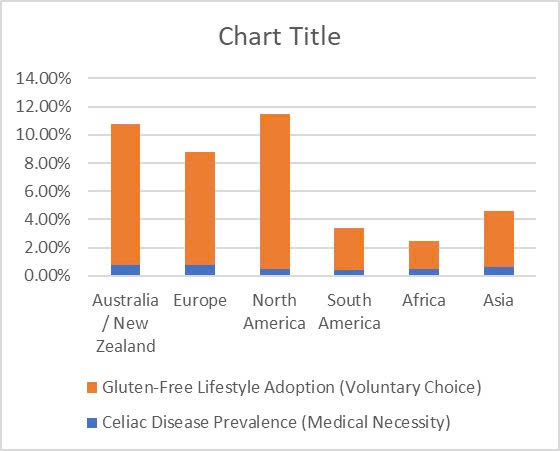
- Orange Bars (Lifestyle Choice): This represents the estimated, and significantly larger, percentage of the population that actively chooses gluten-free products for other reasons, such as perceived health benefits, management of non-celiac gluten sensitivity, or dietary preferences.
(84) 2838484850
Global Prevalence of Celiac Disease
In a new study, researchers conducted a meta-analysis and review of studies from all over the world to estimate the global prevalence of celiac disease and identify possible variations in prevalence between different regions and populations. Prevalence refers to the proportion of individuals who have a condition at or during a particular time period. A meta-analysis is a statistical method used to combine research study data to summarize the results of multiple studies.
The authors reviewed 96 studies published between January 1991 through March 2016 from Asia, Europe, Africa, South America, North America, and Australia. Celiac disease diagnosis was based on a positive celiac-specific blood test, a small intestinal biopsy revealing abnormalities, or a combination of both.
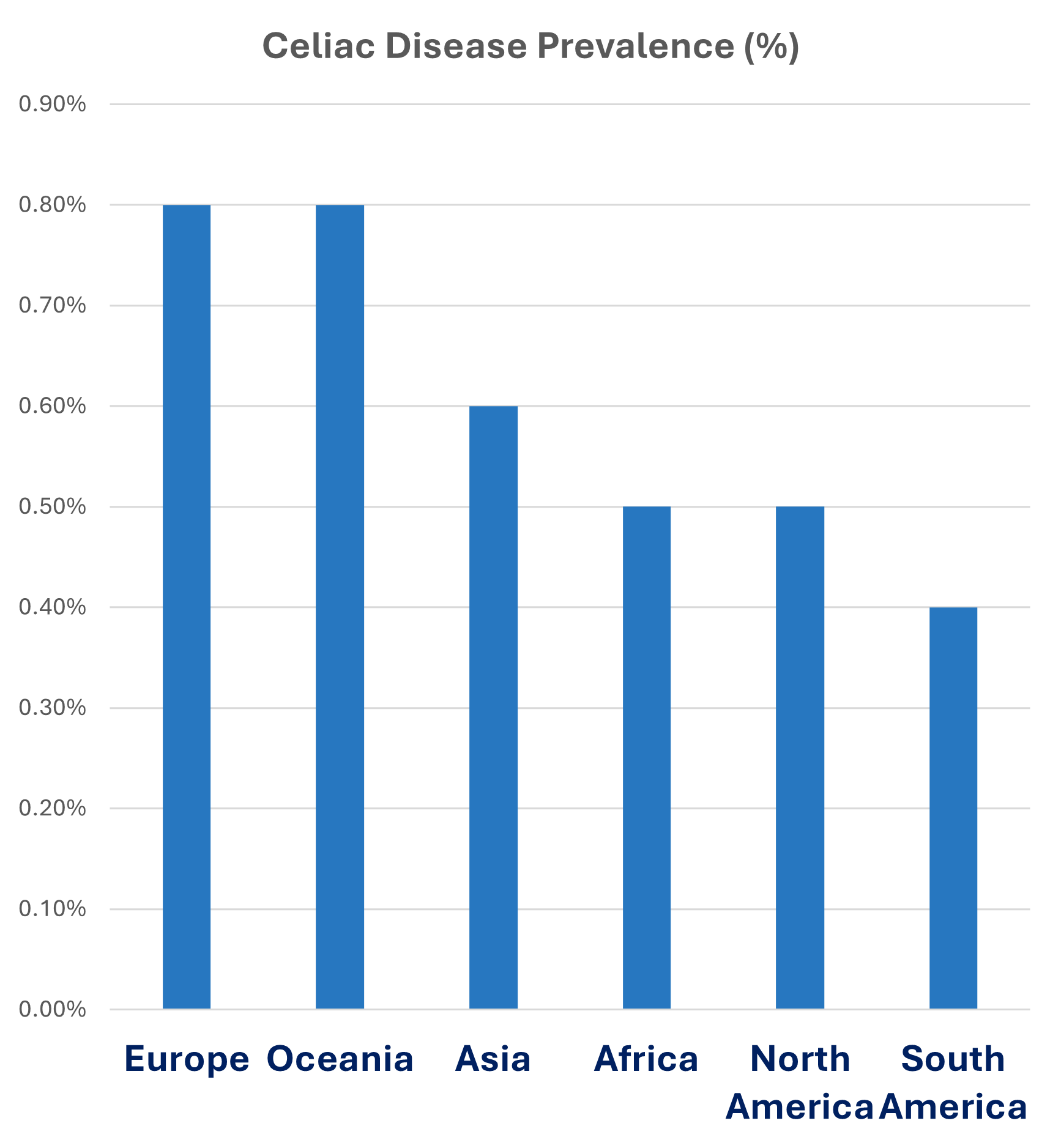
The results of the meta-analysis found the current worldwide prevalence of celiac disease to be 1.4% based on blood tests and 0.7% based on biopsy results. The prevalence of celiac disease was 0.4% in South America, 0.5% in Africa and North America, 0.6% in Asia, and 0.8% in Europe and Oceania. The prevalence was higher in female than male individuals, and was significantly greater in children than adults. In conclusion, the prevalence of celiac disease varies with sex, age, and location.
Source: celiac.org